
About PXE International
PXE International was founded in 1995 to advance research and support individuals and families affected by pseudoxanthoma elasticum (PXE). We work to improve quality of life for people living with PXE by accelerating research, educating clinicians, connecting families, and supporting the development of diagnostics, treatments, and clinical trials.
PXE International conducts, funds, and coordinates research across the path from basic science to clinical application. We also steward intellectual property so that discoveries can be developed equitably into products and services for individuals and families affected by PXE around the world.
To learn more about the origins of PXE International, watch Sharon Terry’s TED Talk or read her articles Learning Genetics and Life as a Numerator
What PXE International Does
- Initiates, funds, and conducts research
- Supports individuals and families affected by PXE
- Provides reliable educational resources for people with PXE and their healthcare teams
- Develops and maintains research tools, registries, and data resources
- Works with clinicians, researchers, companies, and regulators to prepare for clinical trials and treatment development
PXE International is a 501(c)(3) nonprofit organization established in 1995. Our work has been made possible by individuals and families affected by PXE, private donations, foundation support, corporate support, and government funding. Continued progress depends on the generosity and participation of the PXE community and its supporters.
Make a tax-deductible donation at any time.
PXE History
Patrick and Sharon Terry founded PXE International in 1995 after learning in 1994 that their children, Elizabeth and Ian, had PXE. At the time, there was little coordinated research, no genetic test, limited clinical information, and no organized international community for people affected by PXE.
Pat was a fire sprinkler designer and Sharon was a former college chaplain. Neither had formal scientific training. They began by asking what would be needed to move PXE research faster: a registry, a biobank, organized clinical information, research funding, scientific collaboration, and a way for families to participate directly in discovery.
Initial Plan
PXE International’s early plan was built on several principles:
- Move all phases of research forward at the same time to avoid bottlenecks
- Place PXE International between affected individuals and researchers as a trusted steward of samples, data, and participant interests
- Coordinate research centrally to reduce duplication and increase speed
- Participate in national and international genetics initiatives to gain access to tools, expertise, and infrastructure
- Use PXE as a model to improve research systems for other rare diseases
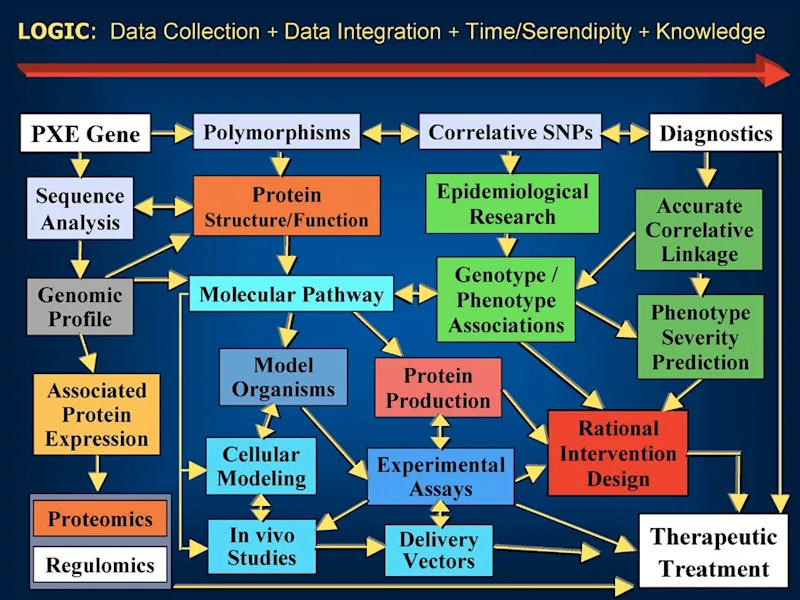 PXE Research Plan. Author: Patrick Terry
Principles of the Plan
- Fast-track all phases of research to avoid bottlenecks
- Position PXE International as a firewall between patients and researchers
- Centrally coordinate research to maximize speed
- Participate in national genetics initiatives to access resources
- Create systemic changes that benefit all rare diseases
Building from the Ground Up
PXE International established a nonprofit organization, enlisted Dr. Lionel Bercovitch as medical director, recruited a dedicated board and staff, and began building the infrastructure needed for discovery.
Early milestones included:
- Conducting gap analyses to identify urgent research needs
- Funding early-stage basic and clinical research
- Creating a large international participant registry
- Founding the PXE International Registry and BioBank
- Coordinating researchers across institutions and countries
- Developing systems for affected individuals and families to contribute directly to research
Discovery of the Gene Associated with PXE
The PXE Blood and Tissue Bank played a central role in the discovery of ABCC6, the gene associated with PXE. Sharon Terry co-authored two Nature Genetics articles reporting the discovery and became a co-inventor on the gene patent, so that the test and subsequent research could advance freely.
This work demonstrated that affected families and advocacy organizations could do more than support research from the sidelines. They could organize the people, samples, data, and collaborations needed to make discovery possible. (Citations here.)
Genetic Testing
PXE International conducted mutation analysis through international laboratory partnerships and the early use of dHPLC and other technologies. These efforts contributed to the identification and cataloging of hundreds of ABCC6 variants and laid the groundwork for diagnostic testing. PXE International has a database of more than 300 pathogenic variants.
PXE International helped to create the federal CETT program, and launched the first genetic test for PXE, improving access to molecular diagnosis for families and clinicians.
Reference:
Shi Y, Terry SF, Terry PF, Bercovitch LG, Gerard GF.
Development of a rapid, reliable genetic test for pseudoxanthoma elasticum.
J Mol Diagn. 2007 Feb;9(1):105–12.
Cellular and Molecular Studies
PXE International has both funded and conducted basic and translational research on the biology of PXE, including studies of ABCC6, mineralization, inorganic pyrophosphate, tissue pathology, diagnostic methods, and potential therapeutic pathways.
Research supported or coordinated by PXE International has included:
- Cellular and molecular studies
- Protein and pathway analysis
- Antibody and assay development
- Animal and cellular models
- Studies of skin, eye, vascular, and gastrointestinal manifestations
- Biomarker and endpoint development
- Clinical trial readiness work
These efforts continue to advance the goal of developing effective treatments for PXE.
PXE Research Meetings
Since 1997, PXE International has hosted international, national, and regional research meetings bringing together clinicians, laboratory scientists, companies, regulators, and lay leaders. These meetings have helped define research priorities, reduce duplication, and build collaborations across disciplines and countries.
PXE International meetings support the development of shared research strategies and helped move the field from gene discovery toward diagnostic development, natural history research, biomarker development, and clinical trials.
Clinical Trials
PXE International has initiated, supported, and conducted clinical studies and trials in PXE. This work includes recruitment, participant engagement, study design input, endpoint development, and collection of natural history data needed to support future treatment evaluation.
Current research priorities include better understanding disease progression, improving outcome measures, supporting biomarker development, and preparing for clinical trials of therapies that may affect the underlying biology of PXE. We are currently working to continue the development of DS1211 and gene therapy for PXE.
Looking Ahead
PXE International continues to work toward effective treatments for PXE. The next phase of progress depends on both science and participation: people living with PXE must be counted, heard, and included in research.
By registering with PXE International, joining studies when eligible, sharing lived experience, contributing data, and supporting research, the PXE community helps make treatment discovery possible.
Without the participation of people living with PXE, we cannot fully understand the condition, design better studies, or move efficiently toward effective treatments. You are the answer. Bring your piece of the puzzle.
Where in the World are PXEers?
Check out our dynamic interactive map showing where PXEers live. People who have given their permission to share their location are represented. If you have not given us permission, your location is not shown.
If you wish to connect with other PXEers in your area:
- Make sure you have given permission to share your information
- Contact the PXE International office (info@pxe.org) to ask for the names and addresses of those who have said they want to share