
PXE Guide: Skin
What Is PXE?
Pseudoxanthoma elasticum (PXE) is an inherited condition that causes abnormal mineralization in some elastic tissues of the body. Mineralization means that tiny deposits of calcium and other minerals build up where they do not usually belong.
PXE most often affects the skin, eyes, and mid-sized arteries. Less commonly, it may affect the gastrointestinal system. PXE was first recognized more than 100 years ago and much has been learned about it in recent decades.
How Does PXE Affect the Skin?
Skin changes are often the first visible sign of PXE. They commonly appear on the sides or back of the neck and may later appear in other areas where the skin bends and flexes. The first skin changes are often small yellowish, yellow-orange, or flesh-colored bumps called papules. These may look like tiny raised spots. Over time, the papules may group together and form larger areas of affected skin. The skin may look slightly pebbled, soft, loose, or wrinkled.
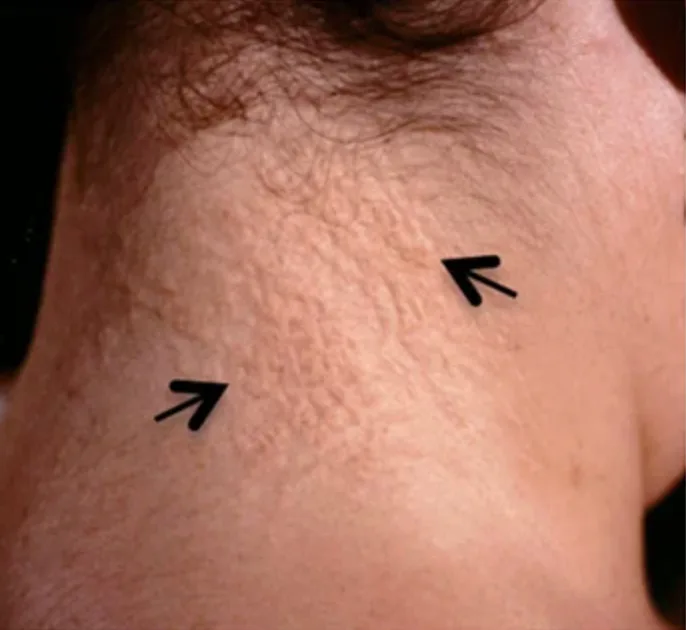
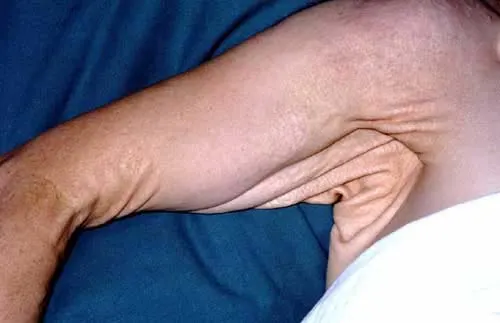
The areas most often affected include:
- Sides of the neck
- Under the arms
- Inside of the elbows
- Groin
- Behind the knees
- Navel
- Inside the lower lip or other mucous membranes
Skin changes are usually symmetrical, meaning they often appear on both sides of the body.
Do Skin Changes Cause Health Problems?
The skin findings of PXE usually do not cause pain, itching, or other physical symptoms. For most people, the main effect is appearance. If you are experiencing any of these other common issues, see a dermatologist for something unrelated to PXE.
The amount of skin involvement varies widely. Some people, especially men, have very mild skin findings. Others develop more noticeable loose or wrinkled skin, especially in the neck, underarms, inner elbows, groin, and other flexural areas.
Skin changes usually progress slowly. At this time, there is no reliable way to predict how much skin will be affected or how quickly changes will occur in any one person.
Can Children Have Skin Signs of PXE?
Yes. Skin signs of PXE can appear in childhood, although the age when they first appear varies. In some children, skin findings are subtle and may be noticed only by a parent, dermatologist, or physician familiar with PXE. A biopsy of the skin on the neck, underarm, or inner elbows of a child will usually show broken and fragmented elastic fibers, if they have PXE.
In other people, the skin findings are not obvious, even when PXE is present. A person can have PXE with very little visible skin involvement.
How Is PXE Diagnosed in the Skin?
A dermatologist may recommend a small skin biopsy to help confirm the diagnosis. In a biopsy, a tiny piece of skin about the size of an eraser is removed and sent to a laboratory.
The skin sample is stained with a von Kossa stain. This is a special laboratory stain used on a skin biopsy. It helps show mineral deposits in the skin. In PXE, the stain can help the pathologist see whether elastic fibers in the mid-dermis are fragmented and mineralized, which supports the diagnosis of PXE.
When visible papules are present, the biopsy is usually taken from one of those areas. If there are no visible skin changes, a dermatologist may choose a site where PXE commonly appears, such as the neck, underarm, or inside of the elbow.
What Happens After Skin Findings Suggest PXE?
If PXE is suspected or confirmed, the next step is usually to look for other signs of PXE. This may include:
- Peau d’orange and/or angioid streaks found through a dilated eye examination by an ophthalmologist or retina specialist
- Pathogenic variants in ABCC6, the gene most commonly associated with PXE Not everyone with PXE develops every possible feature of the condition. Skin findings alone do not predict how PXE will affect the eyes, arteries, or other parts of the body.
Is There Treatment for PXE Skin Changes?
There is no medical treatment that reverses PXE skin changes. Most skin findings do not require treatment. No cream or laser will reach the mid-dermis of the skin, and so they are not effective.
Some people choose reconstructive or plastic surgery to remove loose or redundant skin, especially on the neck or in other areas where the changes are bothersome. Many people heal well after surgery, although scarring, stretching, or recurrence may occur. A surgeon should understand PXE and should discuss realistic expectations before any procedure.
See PXE Guide: Plastic Surgery.
Diet, Calcium, and Skin Progression
In the past, some people wondered whether reducing calcium intake might slow the progression of PXE, and recommendations were even published in medical papers. Calcium restriction does not prevent or slow PXE skin changes. Restricting calcium is harmful, especially for bone health.
People with PXE should follow general nutrition guidance appropriate for their age and health. If recommended by a healthcare professional, calcium supplements should be taken, especially if there is osteopenia, osteoporosis, a history of kidney stones, or another medical reason to monitor calcium intake.
Medications to Discuss With Your Doctor
People with PXE should talk with their healthcare professional before using aspirin or non-steroidal anti-inflammatory drugs, such as ibuprofen or naproxen, especially for regular or long-term use. These medicines can increase the risk of stomach irritation and bleeding. In PXE, gastrointestinal bleeding is uncommon, but it can be serious.
Do not stop a medication prescribed by a physician without medical advice. Sometimes the benefits of a medication outweigh the risks. For example, if someone’s risk of stroke or heart attack is high, this would outweigh the low risk of a gastrointestinal bleed.
Finding Care
The good news is once you are diagnosed, you will have no need to see a dermogologist. The only specialist you need to see regularly is an ophthalmologist, preferably a retina specialist.
Most physicians will not have cared for anyone with PXE. That is expected because PXE is rare and is one of 7000 rare diseases. The most appropriate physician is often one who listens carefully, is willing to learn, and works with appropriate specialists. Even if a healthcare provider has cared for one person with PXE, they have cared for one person with PXE. The condition varies widely from person to person, including within the same family. Experience with one patient does not make someone an expert in PXE. The best healthcare provider is one who listens carefully, remains attuned to individual differences, and is willing to learn from current PXE resources and specialists.
PXE International provides guides for individuals, families, and healthcare professionals. Physicians may also contact PXE International for additional information. Individuals affected by PXE can contact PXE International to help you find a healthcare provider.
Key Points
- Skin changes are often the first visible sign of PXE.
- PXE skin findings commonly appear on the neck and in areas where the skin flexes.
- Skin findings are usually not painful or medically dangerous, but they may affect appearance.
- A skin biopsy can confirm the diagnosis, if someone has either eye signs or two pathogenic variants in ABCC6.
- The amount of skin involvement varies greatly from person to person.
- Skin findings do not predict exactly how PXE will affect the eyes, arteries, or other parts of the body.
- There is no diet or medical treatment that reverses PXE skin changes.
- Reconstructive surgery may be an option for some people.
PXE International
PXE International provides information, support, and research opportunities for individuals and families affected by pseudoxanthoma elasticum.
*Email: info@pxe.org • Phone: 202.362.9599 • Website: pxe.org • © 1995–2026 PXE International.
Except where otherwise noted, educational content in this guide is licensed under a Creative Commons Attribution-NonCommercial-ShareAlike 4.0 International License.